
.png)
If you follow drinking water regulatory news, you already know that a perchlorate Maximum Contaminant Level (MCL) under the Safe Drinking Water Act (SDWA) is back on the table. It’s been a back-and-forth between U.S. EPA and the courts over the last five years, complicated by two changes in administration. The long and short of it is that the U.S. District Court for the Southern District of New York ordered EPA to propose and finalize perchlorate limits under the SDWA, and the agency decided not to appeal the decision.
There’s plenty of good information in the public domain on perchlorate contamination, its impact on human health, and the EPA’s plans to regulate it. In this post, I’ll boil that down and answer some of the most essential questions our drinking water clients are likely to have. If I don’t hit your specific questions, feel free to reach out to me.
Q: What is the timeline for regulatory limits on perchlorate in drinking water?
Originally, the court had mandated that EPA propose perchlorate limits by November 21, 2025. However, due to the recent government shutdown, the deadline for the proposal was extended to January 2, 2026. According to reporting by the ASDWA, this change does not alter the May 21, 2027, deadline for the final rule, as required by court order. As usual, once EPA issues a proposed rule, there will be a public comment period before the agency issues a final regulation.
Q: How common is perchlorate in drinking water?
Perchlorate was one of the thirty compounds in the very first Unregulated Contaminant Monitoring Rule (UCMR 1). Sampling under UCMR 1 occurred between 2001 and 2005, so we’re looking at fairly old data. Nevertheless, the results can still be found on EPA’s website. Out of the 9,950 systems sampled, 647 sample points in 160 systems detected levels of perchlorate above the Minimum Reporting Level (MRL).
Q: How likely is my drinking water system to detect elevated levels of perchlorate?
The detection rate for perchlorate in drinking water under UCMR 1 was about 1.6%, so the odds are on your side – or at least they were back in 2005. On the upside for water system operators, waste containing perchlorate was designated a hazardous constituent under the Resource Conservation and Recovery Act (RCRA) in 2003, and EPA guidance in 2006 confirmed that perchlorate contamination should be considered under CERCLA even though it was never formally added to the list of CERCLA Hazardous Substances. In 2020, EPA issued a press release touting its efforts to reduce perchlorate in drinking water, including remediation activities at 60 Superfund sites.
As with other emerging contaminants, drinking water system operators should look for potential sources of perchlorate in their area. According to EPA, “Perchlorate is commonly used in solid rocket propellants, munitions, fireworks, airbag initiators for vehicles, matches, and signal flares. Perchlorate may occur naturally, particularly in arid regions such as the southwestern U.S. and can be found as a byproduct in hypochlorite solutions used for treating drinking water and nitrate salts used to produce fertilizers, explosives, and other products.”
Water systems located near these sources may be at a higher risk for elevated perchlorate levels, but even systems in less industrialized areas can occasionally report detections due to groundwater movement or legacy contamination from past activities.
Q: What test method(s) are used to measure perchlorate in drinking water?
It’s likely that EPA will specify one or more test methods in its proposed rule. Current EPA test methods for measuring perchlorate in drinking water include Method series 314, which uses ion chromatography to detect and quantify perchlorate at low concentrations. This method has been widely used by laboratories since the early 2000s and is recognized for its sensitivity and reliability. EPA Method series 331.0, which utilizes liquid chromatography-tandem mass spectrometry (LC-MS/MS), can also be used for more advanced analyses when lower detection limits are needed. Additionally, EPA Method 332.0 is approved and utilizes ion chromatography with suppressed conductivity and electrospray ionization mass spectrometry.
Q: What are the perchlorate limits in drinking water likely to be?
It’s always challenging to predict what the proposed rule will be, but we can look at past health advisory levels to get a rough idea. In 2008, the U.S. EPA established a reference dose of 0.0007 mg/kg/day and an Interim Drinking Water Health Advisory of 15 parts per billion (ppb).
Q: In which states is perchlorate already regulated?
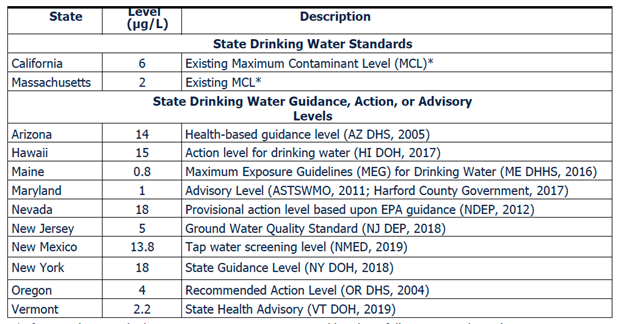
Currently, perchlorate is regulated in drinking water at the state level by several states, most notably California and Massachusetts. California established a Maximum Contaminant Level (MCL) of 6 ppb for perchlorate in 2004, while Massachusetts set an MCL of 2 ppb in 2006. At least 10 other states have issued guidance levels or monitoring requirements.
 Source: EPA Fact Sheet: Steps Water Systems Can Take to Address Perchlorate in Drinking Water, 2020
Q: What types of remediation technologies are recommended for perchlorate removal?
Several proven approaches for removing perchlorate from drinking water include ion exchange, reverse osmosis, and bioremediation. Granular Activated Carbon filtration can also be used; however, the filters may need to be specially treated to increase adsorption for effective perchlorate removal.
Q: Why should I start testing now for perchlorate?
The final rule isn’t expected until early 2027, and public water systems will likely have several months to years to implement remediation measures before it goes into effect. While most systems may not need to adopt perchlorate remediation solutions, it’s important to be proactive. Testing now may also make good financial sense if your system is among the roughly 10% that have detected elevated levels of PFAS. While you’re evaluating PFAS remediation technologies, you may consider adding the ability to remove perchlorate to your requirements.
How Can We Help?
If you have additional questions about perchlorate in drinking water, the regulations, or test methods please don’t hesitate to reach out to us. Our team is always available to provide expert guidance and support, and Pace® is committed to keeping you informed with the latest updates and resources as new regulatory information becomes available.
.png)